
Technology
How Technology Consulting Helps Indian Businesses Grow Faster
2026-05-14 · 7 min read
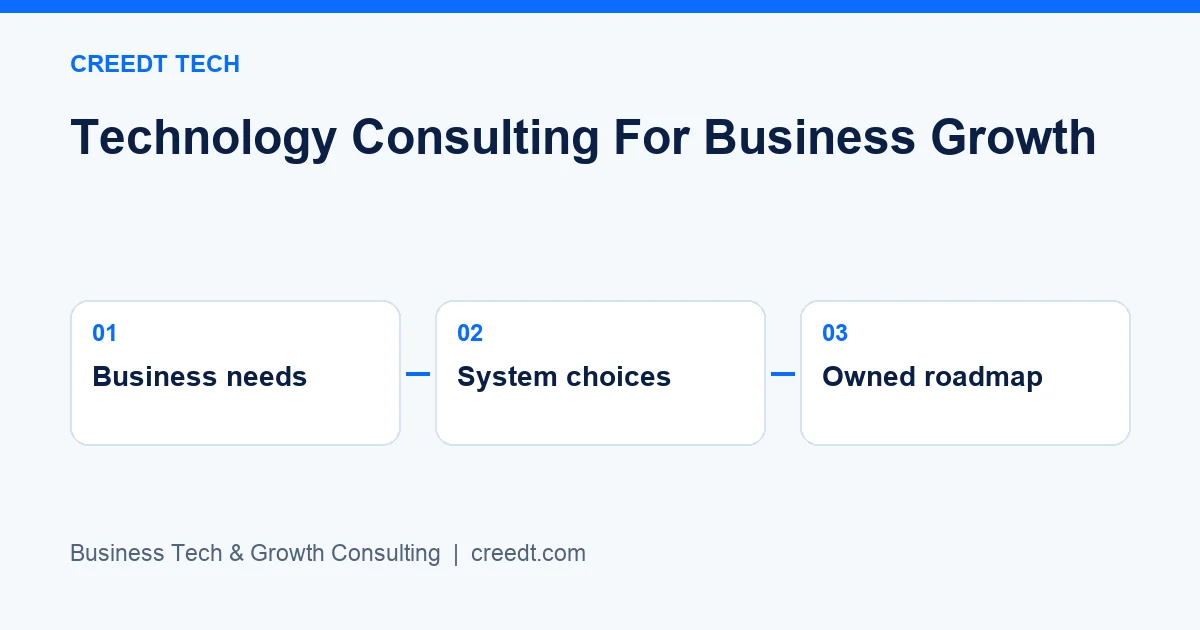
The framework at a glance
Table of contents
Why technology decisions are the real bottleneck
Ask any Indian founder what is slowing them down and you rarely hear the word 'technology'. You hear about hiring, cash, competition, and channels. But scratch the surface and you'll find that many of these problems trace back to a small number of unresolved technology decisions — the CRM that was never fully rolled out, the website that hasn't been rebuilt in three years, the reporting that lives inside one person's head.
Good technology consulting starts by naming these decisions and getting them off the founder's plate.
What great technology consulting looks like
Great technology consulting is business-first. It starts with your goals, your buyers, and your economics — and only then talks about tools. It is vendor-neutral, focused on outcomes, and unafraid to recommend simple solutions.
The right consultant will happily tell you to skip a shiny new platform if a well-configured Google Sheet solves the problem for the next twelve months.
Where Indian businesses commonly get stuck
The most common patterns we see: too many overlapping tools, no single source of truth for customer data, and dashboards that no one trusts. Once these are fixed, growth conversations get sharper almost immediately.
A simple framework for choosing your stack
Start with the customer journey — enquiry, qualification, purchase, delivery, retention. For each stage, ask: what data do we need, who owns it, and where does it live? Only then choose tools that fit.
This inverts the usual buying process, where teams pick tools first and try to bend the business to match.
How to measure the impact of technology consulting
Measure it the way you measure any investment: time returned to the team, lift in conversion, reduction in duplicate spend, faster reporting cycles, and improved employee experience. If a technology engagement can't show at least three of these within a quarter, it isn't working.
FAQ
Frequently asked questions
Is technology consulting only for large companies?
No. Even ₹1–5 Cr businesses benefit from a structured approach to a handful of critical decisions.
How long does an engagement typically last?
Discovery is often 2–4 weeks, followed by an implementation and support phase that can run 3–12 months.
Start with a decision, not a software shortlist
A useful technology review begins with a decision the business cannot currently make well. Perhaps management cannot reconcile sales reports, operations cannot see commitments made by sales, or the team is paying for overlapping applications. Describe the impact and who experiences it. Then investigate the records, systems and handoffs behind the problem. This makes the review accountable to business work rather than a catalog of software features.
Ask each system owner which information they trust and which workarounds they maintain. Disagreement is useful evidence: it often reveals that teams use different definitions for a customer, order or completed task. A roadmap should resolve these definitions before adding another dashboard.
Compare options using ownership cost
License fees are only one part of technology cost. Include migration, staff training, administration, integration maintenance and the effort required to recover from an outage. A cheaper product can become expensive if every report needs manual reconciliation. A more capable product can also be wasteful if no one has the capacity to configure it.
Record what would make the recommendation wrong. For example, a proposed integration may depend on an interface that is available only in a vendor's higher subscription tier. Testing that dependency early is more useful than presenting a confident recommendation that later changes.
Keep the roadmap usable after the review
Break the roadmap into decisions, dependencies and owned tasks. A priority should explain the problem, expected benefit, acceptance condition and the person responsible for follow-through. Separate immediate corrections from changes that need procurement or migration.
Review the plan when the business changes: a new branch, product line or delivery model can alter the requirements. The roadmap is a working decision document, not a forecast that must remain unchanged for a year.
A practical review framework
| Area | Action | Evidence to review |
|---|---|---|
| Duplicate records | Agree a customer identifier | Test duplicate handling |
| Slow reporting | Define the decision and source | Reconcile a sample report |
| Unclear spend | Map renewals and active use | Review unused licenses |
Use this framework as a discussion aid. Start with one row, record the current situation and assign an owner to the next action. The aim is to resolve a useful business decision, rather than complete a checklist without changing how work happens.
Common mistakes to avoid
- Buying tools before understanding the handoff
- Ignoring export and migration limits
- Assigning a roadmap without an implementation owner
Turn the guide into a bounded action plan
Write a short brief covering the problem, the people affected, the records or pages involved and the decision you want to make. Define what is available as evidence and what still needs to be checked. Do not include passwords, private customer information or sensitive internal files in an initial enquiry.
Agree the smallest useful next step, a responsible owner and a review point. If the action changes a live process, include normal and exception paths in testing. Record the result with its limitations; an illustrative example or a short pilot is not proof of a guaranteed commercial outcome.
Editorial information
Published by Creedt Tech. This guide provides general business and implementation information. Examples are illustrative unless identified with substantiated evidence. It does not replace legal, financial, clinical or other regulated professional advice.
Want this working inside your business?
Book a free growth consultation with the Creedt Tech team and turn these ideas into a plan.
Connect with Creedt Tech