
Digitization
Business Digitization Guide for Small and Medium Businesses in India
2026-05-02 · 8 min read
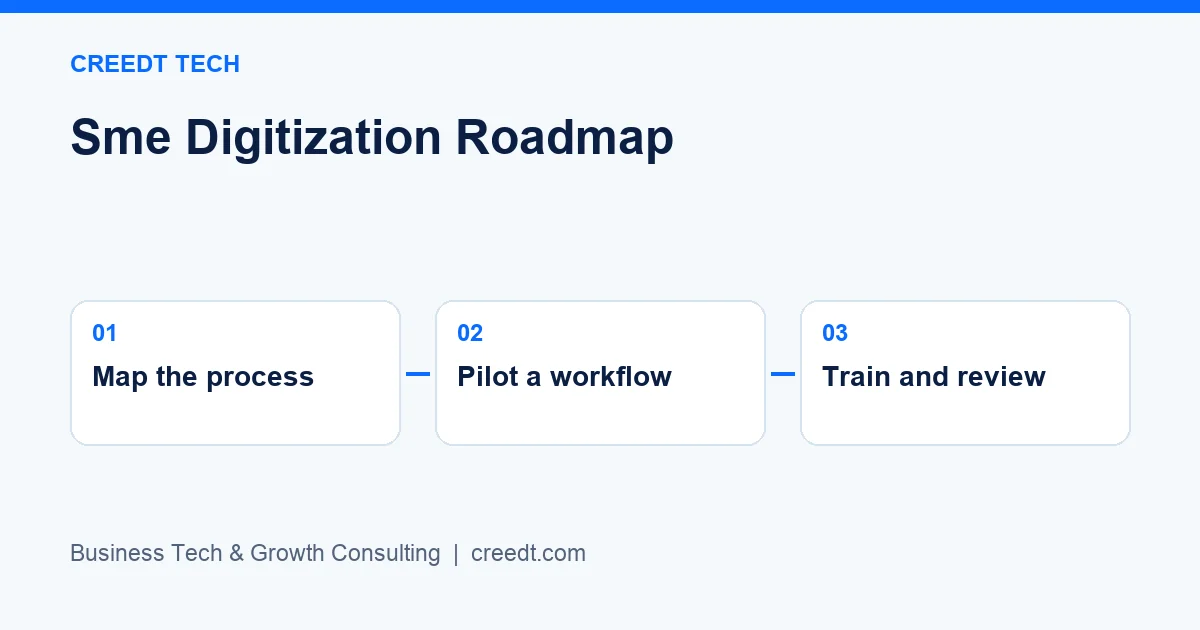
The framework at a glance
Table of contents
What business digitization really means
Digitization is not building an app. It is replacing memory, paper, and personal WhatsApp with shared systems — so your business runs even when a key person is unavailable.
The five workflows to digitize first
Lead intake, quotation, order, delivery, and support. Everything else can wait until these five run cleanly.
Choosing tools your team will actually use
Prioritize mobile-first tools with strong WhatsApp integration. Adoption beats sophistication every time.
Change management for Indian SMEs
Roll out in phases. Reward early adopters. Treat training as a product, not an event.
Measuring success in the first 90 days
Track response times, missed follow-ups, and time-to-report. Improvements here compound into revenue.
FAQ
Frequently asked questions
How much does digitization cost?
Most SMEs invest ₹3–15 lakh for a full lead-to-cash rollout, depending on scope.
Do we need to replace everything?
No — the goal is one connected flow, not a new tool for every problem.
Map one complete operational journey
Choose a recurring process and follow it from the first request to completion. For a purchase request, that means the initiating employee, approval, supplier choice, receipt and record of payment. Write down where information is copied or waits for a person. Ask what happens when a request is urgent, incomplete or cancelled.
Do not start by copying every field from a paper form. Some fields exist because an old approval process once required them. Identify the information that is still necessary and explain why it is collected. A smaller, clearer record is easier for staff to use correctly.
Design for the people who do the work
A digital process needs to suit the devices, connectivity and language used by the team. A form that looks good on an office laptop may be difficult for a field worker to complete. Test realistic conditions and provide a clear way to report an exception.
Training should demonstrate the task, the reason for each status and the action required when something goes wrong. Avoid assuming that every user understands the vocabulary of the software. Keep a concise process guide near the point of use.
Move records in a controlled sequence
Decide which existing jobs will remain in the old workflow and which new jobs enter the pilot. Running both indefinitely creates reconciliation work. Back up existing records, check the imported totals and have the process owner validate representative examples.
Before expanding, review missing fields, rework and tasks with no owner. Improving these details can matter more than adding another automated notification. The pilot is a chance to adapt the workflow before it affects the whole company.
A practical review framework
| Area | Action | Evidence to review |
|---|---|---|
| Paper intake | Digital request form | Required information is complete |
| Approval queue | Named approver and status | Exceptions have a fallback |
| Work tracking | Shared record and owner | Staff can find the latest state |
Use this framework as a discussion aid. Start with one row, record the current situation and assign an owner to the next action. The aim is to resolve a useful business decision, rather than complete a checklist without changing how work happens.
Common mistakes to avoid
- Digitizing a confusing process without simplifying it
- Maintaining paper and digital records indefinitely
- Training only managers while excluding daily users
Turn the guide into a bounded action plan
Write a short brief covering the problem, the people affected, the records or pages involved and the decision you want to make. Define what is available as evidence and what still needs to be checked. Do not include passwords, private customer information or sensitive internal files in an initial enquiry.
Agree the smallest useful next step, a responsible owner and a review point. If the action changes a live process, include normal and exception paths in testing. Record the result with its limitations; an illustrative example or a short pilot is not proof of a guaranteed commercial outcome.
Editorial information
Published by Creedt Tech. This guide provides general business and implementation information. Examples are illustrative unless identified with substantiated evidence. It does not replace legal, financial, clinical or other regulated professional advice.
Want this working inside your business?
Book a free growth consultation with the Creedt Tech team and turn these ideas into a plan.
Connect with Creedt Tech