
Transformation
Complete Digital Transformation Roadmap for Indian Businesses
2025-11-25 · 8 min read
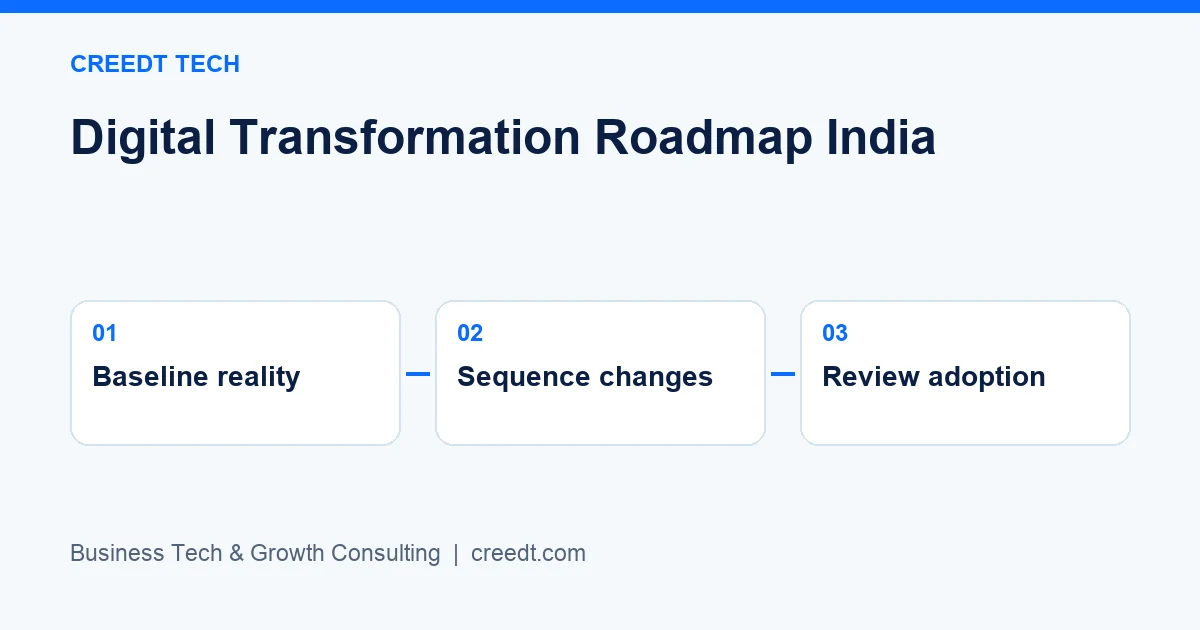
The framework at a glance
Table of contents
Phase 1: Diagnose
Audit current stack, workflows, and data — with brutal honesty.
Phase 2: Design
Blueprint the target state — architecture, tools, and ownership.
Phase 3: Deploy
Roll out in phases; avoid big-bang cutovers.
Phase 4: Adopt
Train, reward early adopters, and reinforce for 90 days.
Phase 5: Improve continuously
Quarterly reviews and a permanent digital roadmap owner.
FAQ
Frequently asked questions
How long is a full transformation?
Typically 6–18 months, with visible impact in the first 60 days.
Where do most transformations fail?
In adoption. Tools are easy; behavior change is hard.
Connect the roadmap to operating outcomes
Digital transformation should describe a change in how the business works, not merely a list of new applications. Identify the customer or operational outcome: a clearer handoff, faster access to reliable information or a more consistent service experience.
Document the current workflow and the limits of the available data. If a baseline cannot be measured yet, make measurement a first-stage task. Present expected benefits as hypotheses until observed evidence supports them.
Sequence dependencies before ambitious features
A dashboard may depend on consistent records. Automation may depend on documented approvals. AI assistance may depend on trustworthy source information and access rules. Put these foundations ahead of the visible features that rely on them.
For each workstream, identify a responsible business owner, technical owner and acceptance condition. Include the decisions that need vendor, security or legal input. The roadmap should make those dependencies visible before a deadline is promised.
Treat adoption as implementation work
A new system is not fully implemented when it is switched on. Staff need training, clear responsibilities and a way to report exceptions. Review actual use and reconcile important records after migration.
Keep a rollback or pause plan for high-impact changes. Expand a pilot only when the normal process and failure handling work. Regular review should revise priorities as the business learns, rather than protecting an outdated plan for the sake of consistency.
A practical review framework
| Area | Action | Evidence to review |
|---|---|---|
| Foundation | Records, owners and access | Reliable sample data |
| Pilot | One bounded workflow | Accepted normal and exception paths |
| Expansion | Training and dependencies | Business owner approves readiness |
Use this framework as a discussion aid. Start with one row, record the current situation and assign an owner to the next action. The aim is to resolve a useful business decision, rather than complete a checklist without changing how work happens.
Common mistakes to avoid
- Calling software installation a transformation
- Starting AI before data and access are understood
- Leaving adoption and support outside the project scope
Turn the guide into a bounded action plan
Write a short brief covering the problem, the people affected, the records or pages involved and the decision you want to make. Define what is available as evidence and what still needs to be checked. Do not include passwords, private customer information or sensitive internal files in an initial enquiry.
Agree the smallest useful next step, a responsible owner and a review point. If the action changes a live process, include normal and exception paths in testing. Record the result with its limitations; an illustrative example or a short pilot is not proof of a guaranteed commercial outcome.
Editorial information
Published by Creedt Tech. This guide provides general business and implementation information. Examples are illustrative unless identified with substantiated evidence. It does not replace legal, financial, clinical or other regulated professional advice.
Want this working inside your business?
Book a free growth consultation with the Creedt Tech team and turn these ideas into a plan.
Connect with Creedt Tech