
Lead Generation
How to Build a Lead Generation System for Your Business
2026-03-27 · 8 min read
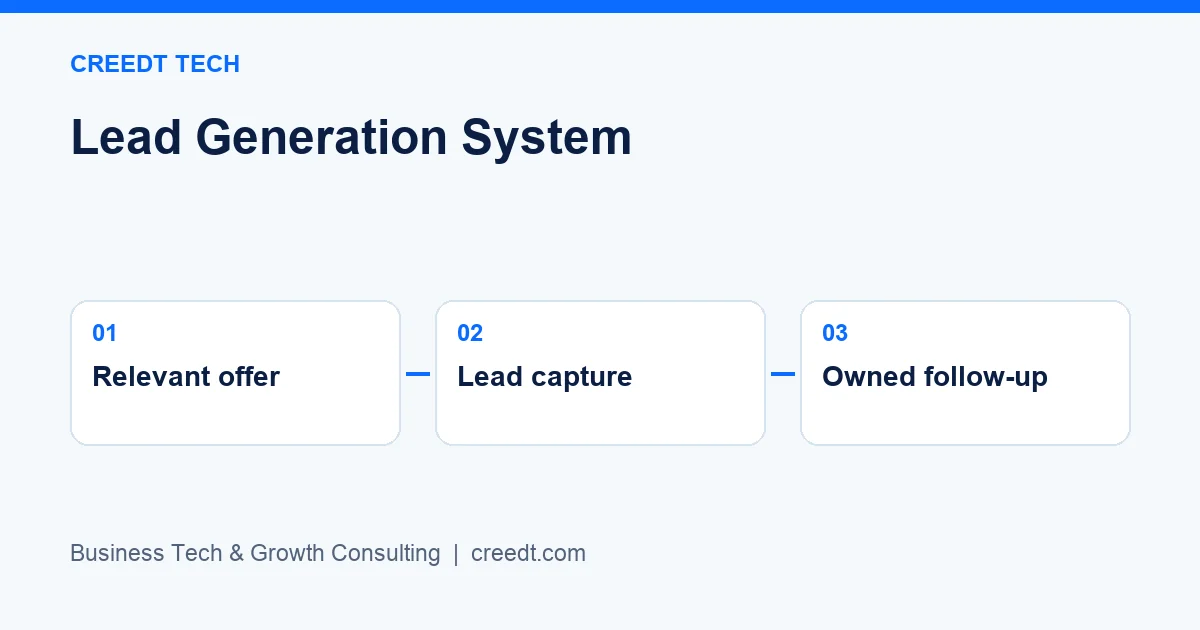
The framework at a glance
Table of contents
The five layers of a lead system
Offer, funnel, channels, CRM, and follow-up. Weakness in any one collapses the whole system.
Getting the offer right
A great offer is specific, valuable, and easy to say yes to. It usually beats better creative.
Channels: what actually works in India
Google search for high-intent, Meta for volume and retargeting, LinkedIn for B2B, and YouTube for education-heavy categories.
CRM and follow-up
Response time under 5 minutes, structured qualification, and automated nurture for slow-moving leads.
Metrics that matter
Cost per qualified lead, meeting-set rate, and revenue per channel — not clicks.
FAQ
Frequently asked questions
How long until leads start flowing?
Typically 2–4 weeks from launch for paid channels; 3–6 months for SEO-led inbound.
Do we need a full-time marketing hire?
Not initially — an outsourced setup with a strong internal owner works well.
Define the enquiry you can actually serve
Start with the offer and the constraints around it. Identify service coverage, project types, minimum information needed to respond and the team that will handle requests. A vague offer attracts vague enquiries and makes qualification harder.
Keep the public form short enough to complete on a phone. Explain how contact information will be used. If a detail is needed only after the first conversation, collect it later instead of making every visitor complete a long questionnaire.
Make lead ownership visible
Every incoming request should have one responsible owner and a recorded next action. Shared inboxes can work for small teams if assignment is explicit. At larger volume, a CRM can help, but software alone does not establish who responds or what a useful response means.
Define statuses around actions rather than ambiguous labels. New, awaiting contact, qualified, proposal requested and closed can mean different things in each business; document your definitions. Record why a request is unsuitable so acquisition teams can improve the offer or targeting.
Test the complete journey before scaling
A successful form animation proves only part of the process. Verify storage, notification delivery, assignment and the ability to reply. Test an invalid contact, a duplicate request and a submission made outside working hours.
Review response time and enquiry quality before increasing paid traffic. If follow-up cannot keep up, more traffic may create lost opportunities and frustrated prospects. Agree a fallback for staff absence and system outages.
A practical review framework
| Area | Action | Evidence to review |
|---|---|---|
| Capture | Form or call record | The request is saved |
| Route | Named owner | A fallback exists |
| Follow up | Scheduled next action | The prospect receives a useful reply |
Use this framework as a discussion aid. Start with one row, record the current situation and assign an owner to the next action. The aim is to resolve a useful business decision, rather than complete a checklist without changing how work happens.
Common mistakes to avoid
- Counting all form submissions as equivalent
- Letting shared inboxes obscure ownership
- Scaling traffic before testing actual notification delivery
Turn the guide into a bounded action plan
Write a short brief covering the problem, the people affected, the records or pages involved and the decision you want to make. Define what is available as evidence and what still needs to be checked. Do not include passwords, private customer information or sensitive internal files in an initial enquiry.
Agree the smallest useful next step, a responsible owner and a review point. If the action changes a live process, include normal and exception paths in testing. Record the result with its limitations; an illustrative example or a short pilot is not proof of a guaranteed commercial outcome.
Editorial information
Published by Creedt Tech. This guide provides general business and implementation information. Examples are illustrative unless identified with substantiated evidence. It does not replace legal, financial, clinical or other regulated professional advice.
Want this working inside your business?
Book a free growth consultation with the Creedt Tech team and turn these ideas into a plan.
Connect with Creedt Tech