
Branding
Branding vs Marketing: What Indian Business Owners Need to Know
2026-04-10 · 5 min read
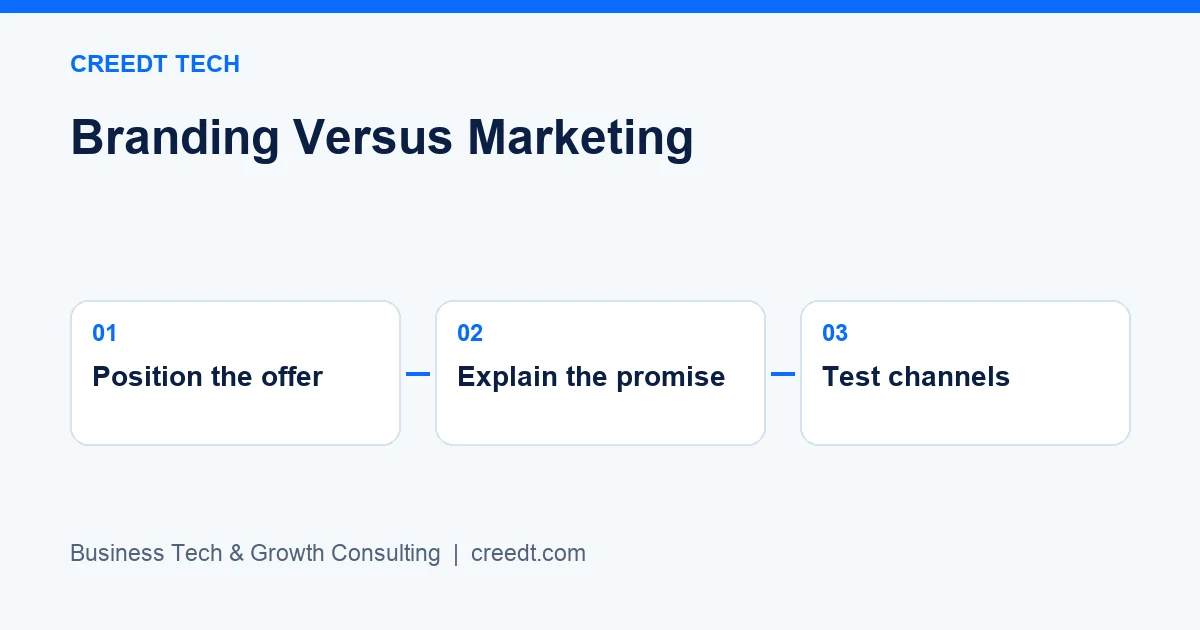
The framework at a glance
Table of contents
The simplest definition
Branding is who you are and what you promise. Marketing is how you show up and repeat that promise.
Why order matters
Marketing amplifies whatever brand exists. Weak brand plus heavy marketing equals expensive noise.
How to split budgets
Early stage: heavy on brand and positioning. Growth stage: heavier on marketing, with brand refreshed every few years.
Signs your brand needs work first
Inconsistent messaging, discount-led selling, and sales cycles that always end in price negotiations.
FAQ
Frequently asked questions
Can we do both in parallel?
Yes, but resolve positioning within the first 30 days before scaling marketing.
How do we measure brand?
Aided/unaided recall, pricing power, inbound share, and NPS trend over quarters.
Branding answers the buyer's choice question
Positioning helps a buyer understand why a service may suit their situation. It includes the audience, problem, promise and credible reasons to consider the business. Visual identity supports recognition, but it cannot make an unclear offer specific.
A useful test is to ask someone outside the business to explain the offer after reading a page. If they can repeat only a slogan, revisit the message hierarchy. Give practical examples and clarify what the engagement does and does not include.
Marketing distributes and tests the explanation
Marketing brings the offer to relevant people through content, search, advertising, events or other channels. The channel should fit the buyer's decision process. An unfamiliar service may need educational content before a direct enquiry campaign makes sense.
If campaigns generate attention but enquiries repeatedly misunderstand the offer, the problem may be positioning or page clarity. If the offer is understood but rarely seen by suitable buyers, distribution may be the constraint. These diagnoses should guide the next investment.
Build a shared brief for both disciplines
The brief should identify the intended audience, their main problem, the evidence available and the next action. Brand work and campaign work then share the same promise. Sales and delivery teams should check that the promise is realistic.
Test changes on a bounded page or campaign before replacing every asset. Measure understanding and enquiry fit alongside attention. A visual preference survey alone cannot establish whether the business message works.
A practical review framework
| Area | Action | Evidence to review |
|---|---|---|
| Branding | Clarifies identity and positioning | Audience understanding |
| Marketing | Distributes and tests the offer | Relevant reach and enquiries |
| Sales experience | Turns interest into a decision | Expectations and fit |
Use this framework as a discussion aid. Start with one row, record the current situation and assign an owner to the next action. The aim is to resolve a useful business decision, rather than complete a checklist without changing how work happens.
Common mistakes to avoid
- Expecting a logo change to fix a vague offer
- Running campaigns with inconsistent promises
- Confusing personal design preferences with buyer understanding
Turn the guide into a bounded action plan
Write a short brief covering the problem, the people affected, the records or pages involved and the decision you want to make. Define what is available as evidence and what still needs to be checked. Do not include passwords, private customer information or sensitive internal files in an initial enquiry.
Agree the smallest useful next step, a responsible owner and a review point. If the action changes a live process, include normal and exception paths in testing. Record the result with its limitations; an illustrative example or a short pilot is not proof of a guaranteed commercial outcome.
Editorial information
Published by Creedt Tech. This guide provides general business and implementation information. Examples are illustrative unless identified with substantiated evidence. It does not replace legal, financial, clinical or other regulated professional advice.
Want this working inside your business?
Book a free growth consultation with the Creedt Tech team and turn these ideas into a plan.
Connect with Creedt Tech