
Digital Presence
Why Every Business Needs a Strong Digital Presence in 2026
2026-04-22 · 6 min read
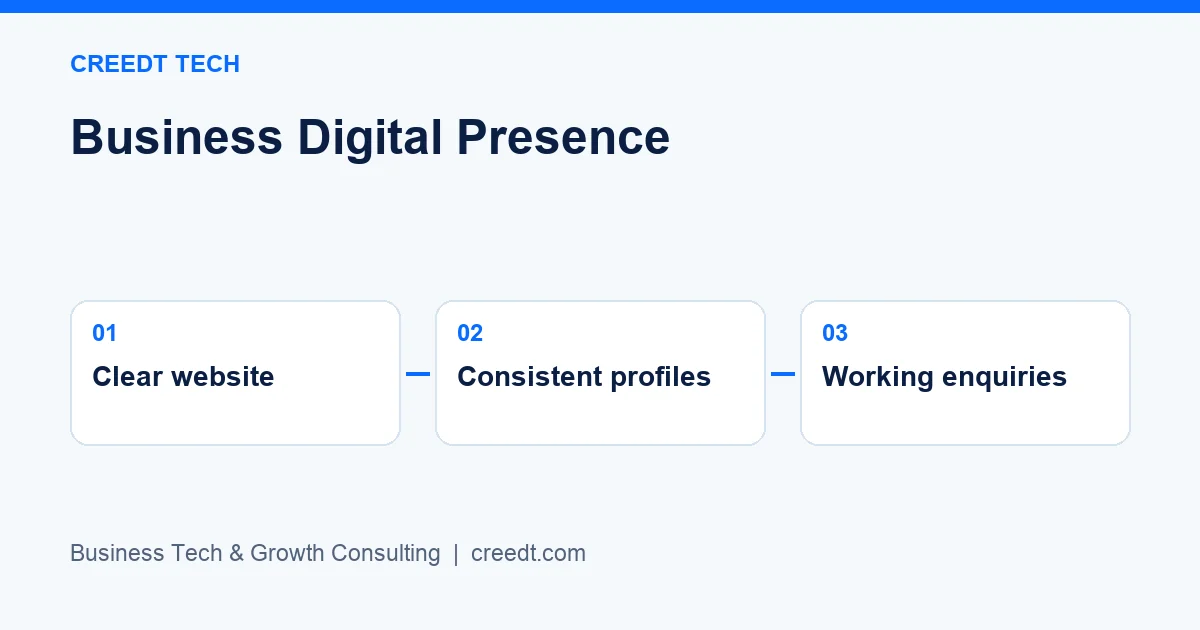
The framework at a glance
Table of contents
The new buying journey
Buyers now discover, research, and shortlist entirely online — often before speaking to a single salesperson.
What 'digital presence' includes
Website, SEO, Google Business, reviews, social profiles, and how AI engines summarize you when someone asks about your category.
How AI search is changing discovery
ChatGPT, Gemini, Perplexity, and Claude are quickly becoming a first stop. Structured content and clear expertise signals matter more than ever.
A checklist for 2026
Fast website, unique service and city pages, schema, updated Google Business, and consistent content across LinkedIn, YouTube, and Instagram.
FAQ
Frequently asked questions
Is a website still relevant with social media?
Yes — a website is the only channel you truly own, and it feeds every other channel.
How often should we refresh our digital presence?
Major overhaul every 2–3 years, continuous content and technical maintenance in between.
Make the business understandable wherever it appears
Digital presence is the combination of information a buyer encounters on the website, search results, business listings and social profiles. Consistency starts with the business name, contact details, service descriptions and geographic coverage. Check these details before adding channels.
A visitor should be able to explain what the business does after reading the main page. Avoid broad labels such as complete solutions without supporting examples. Explain who the service is for, what an engagement includes and how to ask a useful question.
Keep proof separate from promotion
Use evidence the business can substantiate: a documented process, an approved demonstration or a clear description of deliverables. Customer names, photographs and results need permission and context. A generic claim about expertise is less useful than an accurate explanation of how the work is scoped and reviewed.
Business profiles should describe the real operation. A city where the business serves customers is not automatically an office. Do not use unverifiable addresses, reviews or partner badges to fill an empty trust section.
Connect channels to a useful next step
Every active profile should lead to an appropriate website page or contact method. Test the path on a phone, including the form and success response. Assign responsibility for messages arriving through each channel.
Review outdated campaigns, changed phone numbers and broken profile links periodically. A smaller presence with accurate information and consistent response is more useful than an extensive set of abandoned accounts.
A practical review framework
| Area | Action | Evidence to review |
|---|---|---|
| Website | Offer, process and enquiry path | Can a buyer identify the next step? |
| Business listing | Accurate operating details | Does it match the real business? |
| Social profile | Relevant current explanations | Are messages monitored? |
Use this framework as a discussion aid. Start with one row, record the current situation and assign an owner to the next action. The aim is to resolve a useful business decision, rather than complete a checklist without changing how work happens.
Common mistakes to avoid
- Treating appearance as a substitute for clear service information
- Leaving outdated contacts on secondary profiles
- Assuming more channels automatically mean more qualified enquiries
Turn the guide into a bounded action plan
Write a short brief covering the problem, the people affected, the records or pages involved and the decision you want to make. Define what is available as evidence and what still needs to be checked. Do not include passwords, private customer information or sensitive internal files in an initial enquiry.
Agree the smallest useful next step, a responsible owner and a review point. If the action changes a live process, include normal and exception paths in testing. Record the result with its limitations; an illustrative example or a short pilot is not proof of a guaranteed commercial outcome.
Editorial information
Published by Creedt Tech. This guide provides general business and implementation information. Examples are illustrative unless identified with substantiated evidence. It does not replace legal, financial, clinical or other regulated professional advice.
Further reading: Google SEO Starter Guide · Google guidance on AI features and websites
Want this working inside your business?
Book a free growth consultation with the Creedt Tech team and turn these ideas into a plan.
Connect with Creedt Tech