
SEO, AEO and GEO: A Practical Guide for Business Websites
Understand SEO, answer engine optimization and generative engine optimization. Build useful pages, accurate entities and crawlable content without ranking promises.
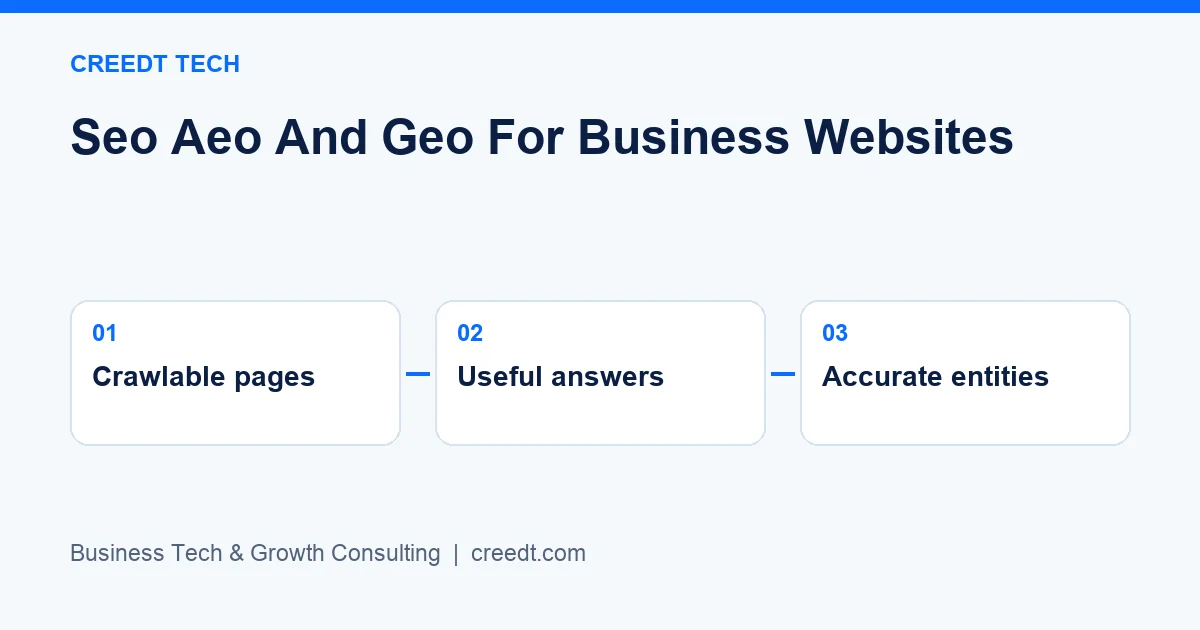
Table of contents
The framework at a glance
Define the terms without inventing a shortcut
Search engine optimization helps a website be discovered and understood for relevant search intent. Answer engine optimization is a term used for making content useful in answer-based experiences. Generative engine optimization describes work intended to help generative systems understand and represent information accurately. AEO and GEO are not universal certification standards or guaranteed submission channels.
The practical overlap is substantial: useful public content, accessible page structure, accurate business information and clear explanations. A business should not pay for a promise of guaranteed recommendations from an AI platform.
Start with technical discoverability
Important pages need to load, be crawlable and have an intended canonical URL. Search directives should distinguish valuable public pages from duplicate or irrelevant archives. A clean sitemap helps discovery but does not force a search engine to index every submitted URL.
Keep important explanations in accessible HTML rather than placing the entire service description inside an image. Link detail pages from appropriate directories and related guides. Use clear navigation and descriptive anchors so people and crawlers can follow the information architecture.
Match each page to a real question or decision
A service page explains a commercial offer: the problem, approach, scope, fit and next action. An informational guide helps the reader understand a topic or complete a decision. A location page should add useful local engagement context; changing a city name across identical content is not a content strategy.
Assign a primary topic to each important page. Related terms can belong within a comprehensive resource when they share an intent. Creating a separate thin page for every keyword variation can produce competing pages and a worse visitor experience.
Write answers with enough context to remain accurate
A concise definition helps a reader orient themselves, but it should be followed by limitations, examples and an implementation explanation. Comparisons are useful when they clarify a real choice. Tables should describe relevant tradeoffs rather than simply placing keywords into columns.
Mark illustrative scenarios clearly. Use factual evidence for client results, credentials or statistics. An answer that is easy to quote but omits a critical boundary can misrepresent the service. The goal is accurate understanding, not a sentence engineered to imply certainty.
Use structured data to describe visible information
Organization, WebSite, WebPage, breadcrumbs and article data can clarify entities and page relationships. Service data should represent a genuine offer. FAQ data should correspond to visible questions and answers. It should not introduce hidden claims or fake ratings.
Schema parsing is not the same as eligibility for a special search display. Google restricts FAQ rich results; a commercial consulting website should not expect them merely because it publishes valid FAQ markup. Keep one coherent schema system and validate the output after changes.
Measure discovery honestly
Search Console can show indexing and search performance for a verified property. Bing Webmaster Tools provides its own crawl and sitemap information. Neither account is established simply by publishing a sitemap link. Verification and submission must be performed through the legitimate owner's account.
AI citations vary by system, query and available sources. There is no general mechanism to submit a site to every AI platform. Track relevant enquiries, useful landing-page discovery and observable citations where available, while acknowledging that manual checks are samples rather than a complete visibility measure.
Prioritize the next useful improvement
Fix broken routes, conflicting canonicals and blocked important content first. Then improve thin explanations and the paths between related pages. Confirm business information, revise unsupported claims and publish useful supporting guides. Improve loading and mobile interaction where measurement identifies a problem.
Keep an editorial review process so changing product features or platform rules do not remain indefinitely in old articles. A useful website is an ongoing publishing and maintenance practice, not a one-time technical submission.
A practical review framework
| Area | Action | Evidence to review |
|---|---|---|
| SEO | Search discovery and relevant page intent | Indexing, landing pages and enquiries |
| AEO | Clear answers with sufficient context | Answer usefulness and accuracy |
| GEO | Consistent entities and comprehensible resources | Observable representation; no guarantee |
Use this framework as a discussion aid. Start with one row, record the current situation and assign an owner to the next action. The aim is to resolve a useful business decision, rather than complete a checklist without changing how work happens.
Common mistakes to avoid
- Promising guaranteed AI recommendations
- Creating doorway pages for keyword variants
- Confusing valid schema with guaranteed rich results
- Claiming Search Console submission without account access
Turn the guide into a bounded action plan
Write a short brief covering the problem, the people affected, the records or pages involved and the decision you want to make. Define what is available as evidence and what still needs to be checked. Do not include passwords, private customer information or sensitive internal files in an initial enquiry.
Agree the smallest useful next step, a responsible owner and a review point. If the action changes a live process, include normal and exception paths in testing. Record the result with its limitations; an illustrative example or a short pilot is not proof of a guaranteed commercial outcome.
Editorial information
Published by Creedt Tech. This guide provides general business and implementation information. Examples are illustrative unless identified with substantiated evidence. It does not replace legal, financial, clinical or other regulated professional advice.
Further reading: Google SEO Starter Guide · Google guidance on AI features and websites
Ready to Build a Smarter Growth System?
Book a free consultation with the Creedt Tech team. We can discuss your current setup and identify a practical next priority.
Connect with Creedt Tech