
AI Readiness for Small Businesses: A Practical Pilot Framework
Assess whether a business workflow is ready for AI. Compare rules and AI, define data boundaries, test output quality and plan human review before a pilot.
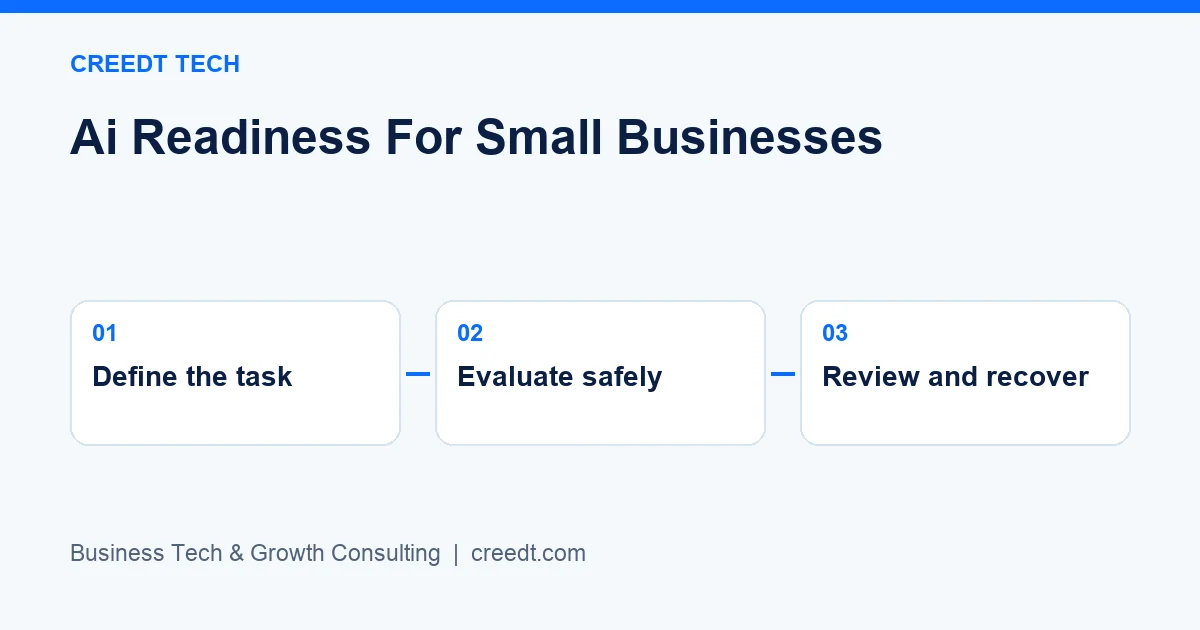
Table of contents
The framework at a glance
What AI readiness means
AI readiness is the ability to define a useful task, provide appropriate information, evaluate the result and manage the consequences of errors. It is not the number of AI subscriptions a business owns. A small company with a well-understood workflow may be better prepared for a bounded pilot than a larger organization with unclear records and responsibilities.
Begin with the decision the task supports. A draft summary for an employee to review has a different risk profile from an automatic customer response or a payment instruction. Make that distinction explicit before comparing tools.
Compare ordinary automation with AI assistance
Use a rule when the decision is stable and the input is structured. A service selection can route an enquiry without a language model. An approved status change can trigger a reminder. These workflows can still fail through missing records or expired access, but their decision logic is explainable.
AI can be useful for a bounded interpretation task, such as suggesting a category for an incoming message or drafting a summary. Its output is probabilistic: a fluent answer is not proof of accuracy. Compare its benefit with the effort required to review and correct it. If the business cannot define acceptable output, it cannot evaluate the pilot reliably.
Create a representative evaluation set
Collect examples that can be used lawfully and safely, removing unnecessary private information. Include normal cases, ambiguous inputs, missing details and requests outside scope. Record the expected result or a clear rubric for judging it. Keep some examples separate from the material used to refine the workflow.
Measure useful categories of error rather than only an average score. A wrong category that delays a routine request is different from a fabricated policy statement sent to a customer. Agree which outputs can be accepted, which need review and which must be rejected.
Set data and access boundaries
Identify where information is sent, who can access it and how long it is retained. Review vendor processing terms and settings before using sensitive records. Do not paste credentials, medical information or confidential customer files into an unreviewed service. Use only the access needed for the selected task.
Separate instructions from the documents the system reads. External messages and web content can contain misleading instructions. An AI workflow should not treat that material as authorization to send messages, reveal records or change a system. High-impact actions need their own checks and responsible approval.
Plan human review and failure handling
Assign an owner who can pause the workflow and investigate errors. Keep the original input available to an authorized reviewer, along with a useful record of the result and correction. Avoid logs that collect sensitive information simply because logging is easy.
Test unavailable services, timeouts, malformed responses and duplicate events. Specify whether the system retries, asks a person or stops. A pilot is not ready for live use until the team understands how to recover and how to prevent a retry from repeating an external action.
Decide whether to expand the pilot
Review the total operating effort: preparation, review, correction, maintenance and vendor cost. Compare that with the baseline task. A model that appears faster can still create more work when exceptions are frequent.
Expand only when the benefit is useful, the limits are understood and the business can support the workflow. Keep sensitive and consequential decisions under the appropriate human control. AI readiness work should make an investment decision clearer; it should not promise that every task needs AI.
A practical review framework
| Area | Action | Evidence to review |
|---|---|---|
| Predictable routing | Rules | Missing input and duplicate handling |
| Message categorization | Evaluated AI assistance | Ambiguity and correction rate |
| External action | Controlled workflow with approval | Permission and recovery |
| Sensitive decision | Qualified human review | Consequences and accountability |
Use this framework as a discussion aid. Start with one row, record the current situation and assign an owner to the next action. The aim is to resolve a useful business decision, rather than complete a checklist without changing how work happens.
Common mistakes to avoid
- Selecting a tool before defining acceptable output
- Evaluating only easy examples
- Allowing external documents to authorize actions
- Ignoring review cost when reporting efficiency
Turn the guide into a bounded action plan
Write a short brief covering the problem, the people affected, the records or pages involved and the decision you want to make. Define what is available as evidence and what still needs to be checked. Do not include passwords, private customer information or sensitive internal files in an initial enquiry.
Agree the smallest useful next step, a responsible owner and a review point. If the action changes a live process, include normal and exception paths in testing. Record the result with its limitations; an illustrative example or a short pilot is not proof of a guaranteed commercial outcome.
Editorial information
Published by Creedt Tech. This guide provides general business and implementation information. Examples are illustrative unless identified with substantiated evidence. It does not replace legal, financial, clinical or other regulated professional advice.
Ready to Build a Smarter Growth System?
Book a free consultation with the Creedt Tech team. We can discuss your current setup and identify a practical next priority.
Connect with Creedt Tech